Written by Sterling
The year is 2004. Mad cow disease was all the rage, the Red Sox won the World Series, and the shelves of Gamestop were flooded with used copies of Madden 2003 and Karaoke Revolution with its sequels and spinoffs. This was a herald of what was to come. The early tremors that scatter the rodents and birds as a new wave of something titanic approached. Just two years later if you visited a Gamestop wandering the mall waiting for your showing of The Da Vinci Code, you would be in the thick of the plastic instrument tidal wave spawned by the creators of Karaoke Revolution. Guitar Hero II was out and rhythm gaming had arrived in the west in a way that took up space in living rooms and made parties for the next console generation a blast!
This was not where Harmonix started though. The game studio had been around for years prior to Karaoke Revolution’s release, even. The company started when Eran Egozy and Alex Rigopulos met going to school at MIT and bonded over their shared love of music and tech. After graduation they founded the company, got some investment cash from friends and family, and burned it immediately building and testing weird peripherals. The only product the company really cites for this time period on their website is The Axe. To quote Alex about it from a 2009 interview with CNN¹, “It wasn't a game, it was a joystick music improvisation system.” It didn’t sell well. Or even much at all. But it did get the team’s foot in the door to start talking with major companies for more serious work. They ended up developing an interactive exhibit for Disney World’s EPCOT². They also got in contact with Dave & Busters and started bridging out to Japanese karaoke bars. On a trip out to Japan, Alex had a bit of a moment:
I was watching people interact with our product, and the realization came crashing down on me -- we had spent 18 months on a music system that was fundamentally flawed. Karaoke isn't about personal expression. It's about people reproducing the songs they know as accurately as they can. The whole notion of adding improvisation elements just wasn't connecting. So I retreated to my hotel room and was depressed for the next two days.
The company refocused and learned a lot from the Japanese rhythm games out there citing particular inspiration from the Dance Dance Revolution series as well as the works of Masaya Matsuura (PaRappa the Rapper, Vib-Ribbon) and Tetsuya Mizuguchi (Space Channel 5, Rez, much later Tetris Effect). As I played through the majority of Harmonix’s catalog for this piece, these influences are apparent even in pretty small ways. The concept of encouraging players to just sit down and play through a game like an album feels very PaRappa and Harmonix’s Amplitude (2016) follows that formula exactly while their Rock Band games have you run through sets of songs in a presentation that feels similar in concept. Rez is a game that involves traveling through vast abstract spaces and Harmonix’s early PS2 releases of FreQuency and Amplitude have you traveling through such environments to hit notes rather than the notes coming towards you.
Which brings me to their first proper home console releases: FreQuency and Amplitude (the latter of which feels nearly like a strict upgrade of the former). The games feel like early prototypes for what would become Guitar Hero with tracks of notes coming towards you that you can switch between to make a song. The games play on a standard PS2 controller and there are three columns of notes coming at you which you hit with L1, R1, and R2. It works, but it already highlights the friction between the design goals of Harmonix and the limitations of the controllers that had well become the standard at this point. In the gameplay, hitting enough notes in a row activates an instrument track in the song so the better you do the more complete a song feels by the end of a level. If you struggle you might just have the vocals and the bass line playing as you barely scrape over the finish line. Additionally, each of these games has a small piece of gameplay to let players self-express, an important part of Harmonix design ethos even after Alex’s revelation in Japan. Among their first games, FreQuency actually allows for more freedom in that self expression. The game incorporates freestyle tracks you can use when you have some breathing room during gameplay, but they become harder to incorporate as the difficulty increases. Amplitude turns this freestyling into a powerup that mostly feels like a button that lets you just wiggle the control stick for points for a few seconds. Both of these games notably have special remix modes where you can turn the instruments of the tracks used in gameplay into your own musical creations that you can save to share on your memory card.
These projects gave Harmonix incredible experience and resulted in some interesting games, but the biggest impact these products had was that it put Harmonix in the green for the first time and solidified that their future was fully in gaming. Also FreQuency has the most 2001 intro to a video game I’ve ever seen.³
Harmonix went back to peripherals with the Karaoke Revolution games which were an immediate success, USB microphones and all! Konami made a great deal picking up this company for publishing and got 5 games out of them before they handed off the reins of the franchise to other developers, but this put Harmonix in a position not just to survive but to grow! Among this cluster of karaoke games was also a small dabbling into the EyeToy with a non-music game. Remember the EyeToy? If not, it was basically a low-tech Kinect. Don’t know what a Kinect is? We’ll get to it. Back to Alex:
[EyeToy: AntiGrav] turned out to be the worst-reviewed game from a critical review standpoint, yet it sold four times as well as Frequency and Amplitude.
We got really gloomy. We started to wonder if everything we were trying to do was just a fool's errand. When it came to making music games, we couldn't make any money or even a return for our investors. We were paying the bills, but to go on with the business would have been a departure from the founding premise of the company. It would have been an emotionally and psychologically crushing defeat.
However, right around that time we were contacted by RedOctane, a small company that had some experience with peripherals. They said, 'Hey, we love your games. If we make a guitar controller, will you make the guitar game?'
That one question would end up defining the rest of Harmonix’s history. Shoutouts to RedOctane! These guys saw an opportunity, took a swing, immediately saw the results rocket to immense success, got bought by Activision and closed four years later in 2010. They didn’t deserve that, but in theory they’re back and are working on a plastic instrument game they announced in 2026 called Stage Tour. I’ll keep an eye on it!
In 2005 Harmonix came out with Guitar Hero. A year later, Guitar Hero II. If you did not live through this time period you might not realize how big of a deal this was for the games industry. Seemingly overnight if you had one of these games and a couple controllers folks were kicking down your door to come over and play! South Park made an episode making fun of it! Jimmy Page got pissy about these games! There was a marketing split where Gibson was tied to the Guitar Hero games and Fender was tied to the Rock Band ones. Aerosmith made more money from Guitar Hero Aerosmith than from any single album’s sales! I bought Guitar Hero Aerosmith! Why did I buy Guitar Hero Aerosmith??? I hate Aerosmith!
One of my favorite Wikipedia articles is Wikipedia’s list of highest grossing media franchises⁴. It puts a lot of major corporate decisions into perspective. Here you can find that Hamtaro has grossed more than Terminator and that Space Invaders has made more money than James Bond. Guitar Hero barely makes it toward the bottom of this list, but the fact that it’s on this list above Neon Genesis Evangelion and barely below Resident Evil is worth noting!
This huge enterprise was started by a couple of guys out of Cambridge, and later when they moved offices, Boston. And by the time they were making Guitar Hero it was more than just a couple of guys. The team had expanded and was full of musicians!
I hopped on a video call to interview a former Harmonix employee for this piece. He worked for the company for 17 years across a wide range of roles and he was able to talk shop with me about so many of the historic details of this company. Going forward I’ll be referring to the former Harmonix employee I interviewed as FHE. When I asked him about this time in the company’s history and what the vibe was like, especially with so many team members having active music projects, he had this to say:
That was, like, a huge thing early on yeah, especially in the Cambridge years. You know, like the late 2000s, people would just be posting on the internal newsgroups, this was before slack, we used actual newsgroups, but people would just be like, hey I have a concert at The Middle East⁵ or whatever, like the bar down the street. And that would be a thing, people would go to the shows after work.
As the development team was becoming close-knit, their consistent output was getting attention from bigger companies. RedOctane and Harmonix created three Guitar Hero games putting their IP as a household name. Then Activision bought RedOctane as mentioned above and Harmonix got bought by Viacom around the same time, splitting up the band as it were. RedOctane continued to make Guitar Hero and Harmonix made the less popular but still quite successful Rock Band series, taking what it learned and expanding the gameplay to include drums and vocals to make it one of the best party games of all time. I first played Guitar Hero II in my neighbor’s basement because that seems to be how everyone tried these games the first time. I was hooked and spent the next few years of my life jamming on Guitar Hero and Rock Band games in various basements and parties and having an incredible time!
During this period from 2006-2010 I played so much of these games that I was regularly jamming expert difficulty on the plastic guitars everywhere, my favorite of which was Rock Band 2 which was a staple at the semi-regular parties I would host with my friends. These games infected my musical tastes for years just in time for me to get into the college radio scene where this enthusiasm for music likely carried me through years more of soaking in the music around me like a sponge. I still remember the panicked terror of my friends and I seeing Foreplay/Long Time come up in Rock Band 1. I probably could play the intros for Spoonman and E-Pro in my sleep. If I had any money in that part of my life I would probably have picked up Rock Band 3 and a pro controller, a peripheral that pushed back against common criticism of the game by people who were not the target audience. “Why would you play this when you could take the time to play a real instrument” the masses would ask as they watched their 30th football game of the season. Harmonix’s response with Rock Band 3 was, in the parlance of our times, “bet” as they released a 102-button 6-string controller for sickos and made sure all the songs in the game were compatible.
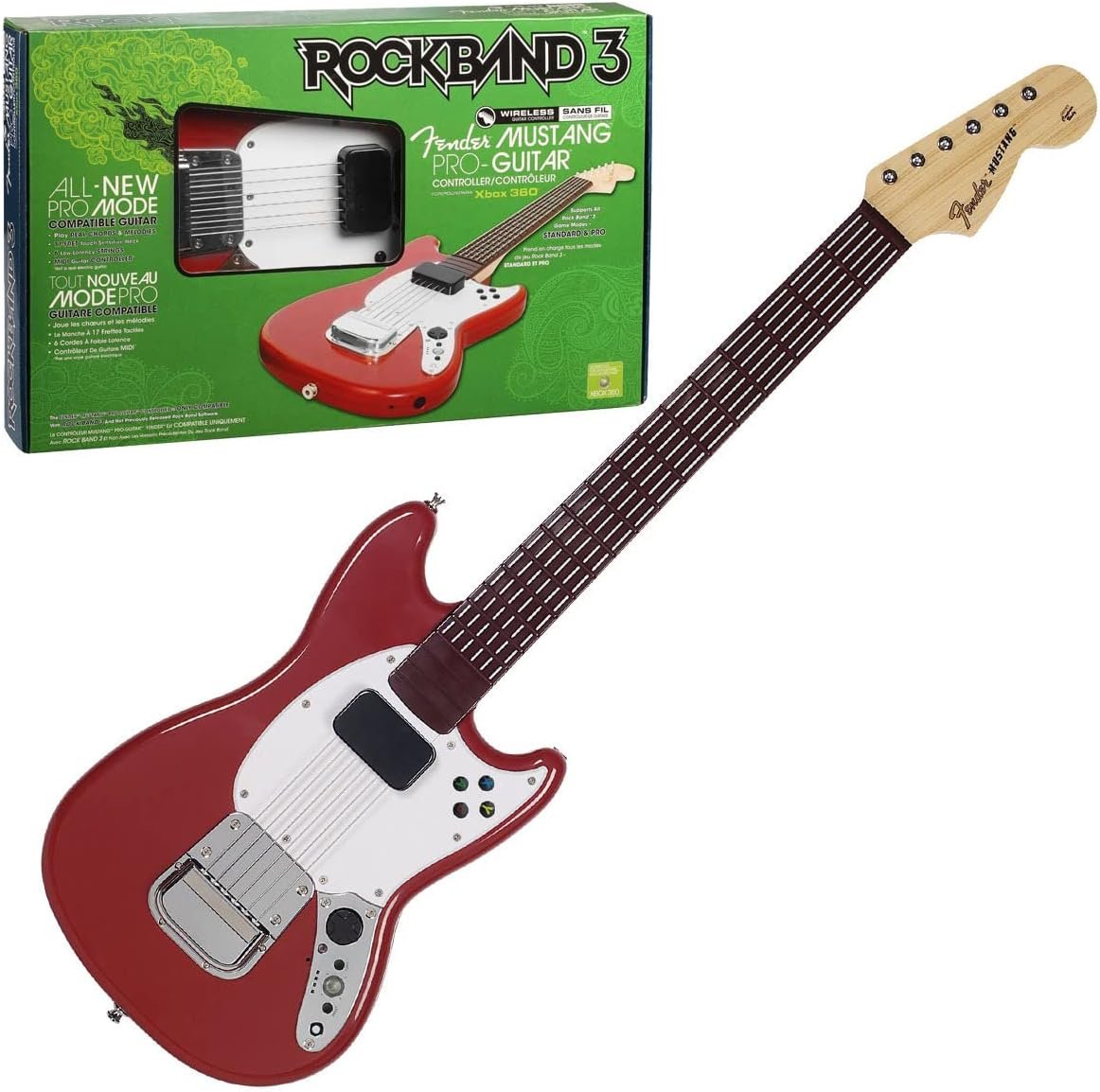
The Rock Band franchise continued with some ambitious projects like The Beatles: Rock Band which acted as a stylized documentary of The Beatles which is still an incredible piece of gaming achievement, but the plastic instrument craze was dropping in popularity, fast. It was dropping fast enough that EA, at the height of a major acquisition rush, declined to purchase Harmonix, describing it as a “falling knife.” In 2010 Harmonix became independent once more after wrenching hundreds of millions of dollars from Viacom via lawsuits over not paying them appropriately.
While being independent in the games industry means a lot of positives for your team’s creative control, it isn’t great for funding as Harmonix entered a weird phase where funding was once again something they needed to hunt for. The hunt led them to major companies looking to push new peripherals and needing killer apps for them. Luckily for Harmonix, Microsoft was pushing the Kinect. The Wii had recently done frankly stupid sales numbers shaking the games industry to its core and game CEOs were convinced that motion controls were the future. They were trying to jam them in everywhere, especially where they didn’t belong (sounds familiar in 2026) and it made the capital-G Gamers grumpy. That said, it did bring in a new casual audience to some extent. Never as strongly as the Wii, but the Kinect with its super-advanced body tracking camera tech was at least more successful than the Playstation Move. With Ubisoft’s Just Dance games taking off on the Wii, it made sense for the development of a competitor dance game for the Kinect, but it’s also very likely Harmonix’s Dance Central was well into production when Just Dance released.
Dance Central and its sequels kept things steady for Harmonix for a bit but it was clear they needed to find a new audience and they started getting weird with it to very mixed results. They made a few mobile games, releasing Rock Band Mobile and even an old iPod clickwheel game called Phase. They made A City Sleeps, a clearly smaller-scope rhythm shooter that is full of Steam reviews that are just confused as to why Harmonix made this. FHE notes “I think that was when we internally realized we were making the same kinds of games and we can’t do that forever.” They worked with Counter-Strike: Global Offensive developer Hidden Path to make a competitive rhythm FPS named Chroma that never got released but had a lot of press buzz around. They even worked with Disney again to make Fantasia: Music Evolved which is a Kinect rhythm game where you’re conducting music as a wizard with your body which, frankly, kicks ass.
This is an era where co-founder Alex Rigopulos steps down as CEO finding more creatively fulfilling work elsewhere in the company. Between conversations and personal accounts, Alex has clearly been nothing but a delight to work with and is a talented personality still full of knowledge that is happy to pass it on to his team. To quote FHE:
He’s done so much regular development you can talk to him like a developer and not an executive, you know what I mean? So it’s just, like, working through some problem with calibration or whatever and he’s like “oh, well, here’s how we solved that on this game.”
Also among the funding options Harmonix sought was crowdfunding. Kickstarter had started taking off as a big deal around this era and on May 17th, 2014 they started a campaign to make a reboot of Amplitude. The kickstarter page is still up⁶! You can see that the campaign just barely got funded, but it’s scoped well and has some goofy pledge tiers like a jam session with Harmonix and a helicopter tour of Boston! The final product does in fact look very similar to what they expected in the campaign and Amplitude (2016) is a blast! FHE points out “pledges over time, if you look at that there were a ton very late which made me think some of those were potentially internal people that were making sure it got over the hump.” They also failed to crowdfund the PC port of Rock Band 4 via the platform Fig with a dinner with Tim Schafer as a potential backer reward⁷.
Obviously crowdfunding wasn’t getting Harmonix what they needed, but a new area of peripherals was taking off. VR is a fascinating platform that has so much design space that can be explored and unfortunately I have to rearrange my entire living room every time I want to try it. Every VR platform wanted more games to get folks in the door and Harmonix at this point were old pros at full body motion control. Well positioned for the market opening up in the space, they dove in, cranking out Harmonix Music VR for the PS4, SingSpace for the Samsung Gear VR, and Rock Band VR on Oculus Rift. Rock Band VR was the big budget one, but the one that stuck out to me from this collection was Audica which was for basically all the VR platforms but, for reasons I’ll get into later, you can only get it on Steam now. Audica is a smaller scope game than a lot of their other VR work, but the game is polished to a mirror shine. It’s a shooter where targets appear and you have to shoot them to the music. It’s straightforward, has a small list of actual mechanics, and is a game I could play for hours if my VR headset battery would last for hours.
While this VR explosion was happening at the company they still continued other different projects. They developed a small scale rhythm game Beat Sports for the Apple TV which had a Switch sequel, Super Beat Sports. They made a huge expansion for Rock Band 4 called Rock Band Rivals which was a foray into a live service game model for them with players competing over seasons in a nonstop battle of the bands. They made a karaoke game for Twitch streamers to play with their chat called Twitch Sings.
They made an interesting foray into physical gaming with Hasbro called DropMix. DropMix allowed players with NFC cards of different songs from collectible packs to mash them together like a SoundCloud shitposter.
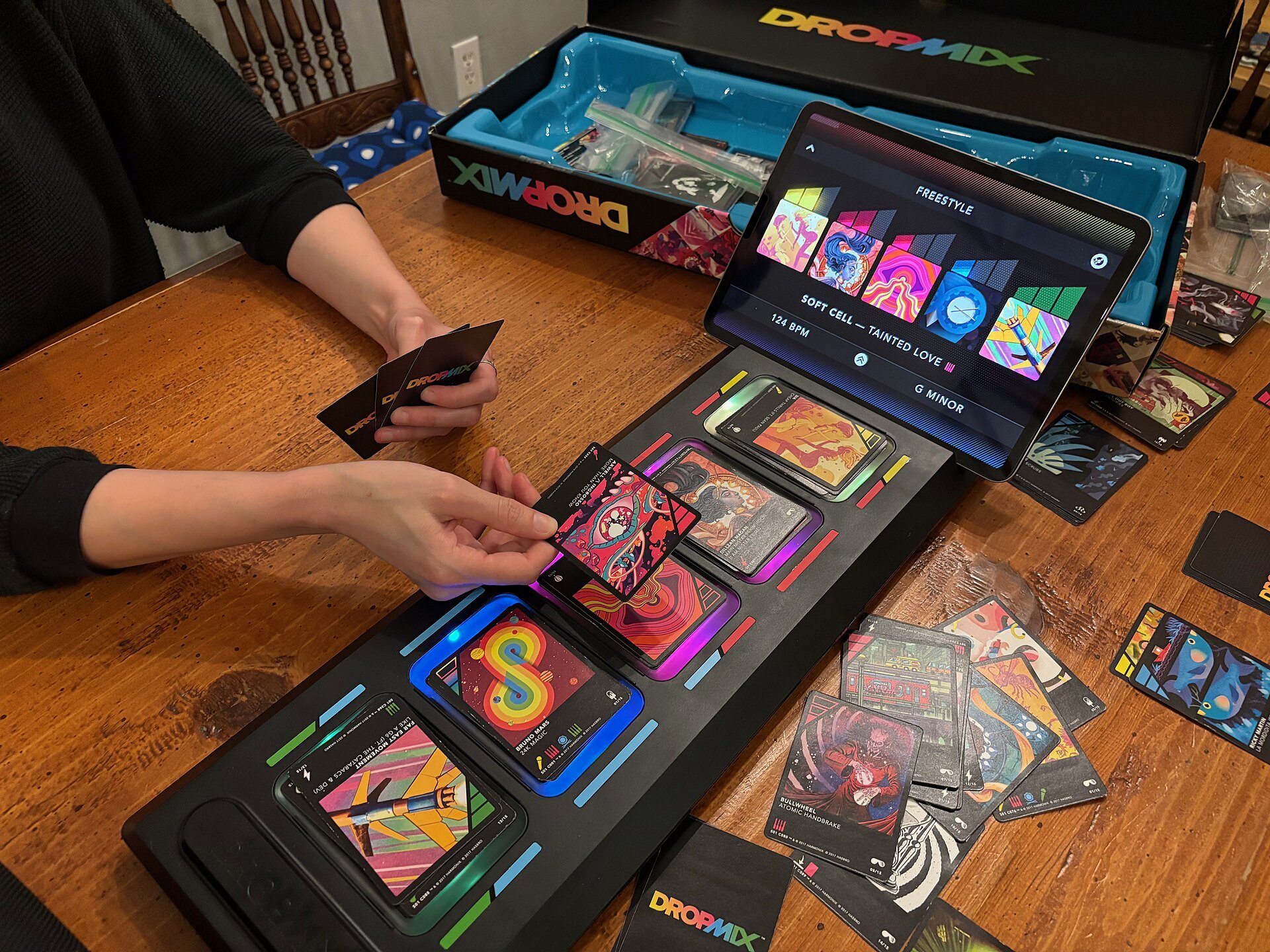
So if you wanted the drum track of Bangarang backing the vocals of All About That Bass with the guitar track from Take Me Out you can do that! It would probably sound terrible, but you could keep trying these combinations until you found something that worked. When you hit gold with a certified banger, you could upload your mashup to socials. This idea took off and the game was nominated for, and won, a lot of awards. It also marked the beginning of a new phase of Harmonix.
I asked FHE about the inspirations that Harmonix took from elsewhere in gaming in more recent years. The early influences are still strong in Harmonix but the rhythm game space has still had notable entries since.
Harmonix is kinda insular in that way. Maybe because we make a lot of sequels or maybe because we kinda just make the same couple of types of games. A lot of people would come in and sort of do what you were doing of, like, look at old Harmonix games and learn how they worked. … People individually have their own inspirations for sure, but as a studio there’s not been a thing where it’s like, “alright everyone, make sure you’re up to speed on X because we’re making that kind of game.”
Which makes the lightning that DropMix struck feel even more exciting. This was lightning that turned into Fuser, one of my favorites from the Harmonix catalog. Fuser took the ideas of DropMix and made them come alive in a digital format, giving the player a full DJ booth, a massive catalog of songs to fuck around with, and professional level effects and tools to make it all sound great! Fuser is creativity software disguised as a video game.
“I remember us struggling with during development of, like, how much of a game should this game be,” FHE said. They chose right. There’s enough game in the campaign to teach you how to use your powerful DJ booth and by the time you’re done you just want to fuck around in freestyle mode forever! The game has an incredible selection of songs and the way it makes you think about music helps you appreciate it on a different axis. Never Gonna Give You Up has a killer drum track for this game. Tossing in the vocals for Donna Summer’s Hot Stuff is always welcome! Every single instrument track of The Vengabus demands to be mashed with anything, so badly! Fuser was a game that was important to me mid-pandemic when I discovered it. It led me to running DJ sets for friends over Discord calls and I still open it up to just try stuff every now and then, especially with how incredibly active the fan modding community is to this day. The default track list is already incredible, but being able to toss in PaRappa songs mashed up with Neil Cicierega’s Two Trucks is a feeling that this strong modding scene will help you with gladly!
December 2022, about two years after the game’s release, Fuser was pulled from digital purchase and shut down.
Around that time a lot of Harmonix games got pulled from digital storefronts. Most of the VR games I wanted to try for this research I simply couldn’t get and I am frankly surprised Audica was still available for purchase.
The reason for all this is that Harmonix was no longer independent as of November 2021. As with going independent in the first place, this is a mixed bag. On the one hand, Harmonix would have some space to not worry about funding as much. Getting new funding for the previous decade of their existence was likely fighting tooth and nail the whole time. They had some wiggle room to experiment and try new stuff, but having ownership by another company would no doubt help stabilize things. If you want a taste of how difficult securing funding as an independent development team is, I strongly recommend Noodle’s YouTube video “how does an indie game get made?”⁸
The new owner for Harmonix was Epic Games, most known these days for Fortnite. Remember that Wikipedia article of highest grossing media franchises I talked about above? As of writing, Fortnite has an estimated revenue 450% of Guitar Hero’s (most of Guitar Hero’s revenue went to Activision, not Harmonix), placing them just above Mario and below Thomas the Tank Engine. Seriously, great Wikipedia article. Harmonix was acquired because Epic Games wanted to expand the offerings of Fortnite and make sure people knew it wasn’t just the battle royale mode. When you have more money than god in the games industry, that means you buy companies and Harmonix was probably happy to take that security of funding. It wasn’t without some concerns internally, especially with how many of their games were pulled from digital shelves most likely due to Epic not wanting to renegotiate music licensing costs, but Harmonix got to work on developing rhythm games for Fortnite which became the game mode Fortnite Festival. This has been what Harmonix has been working on since up until time of writing. It is possible they are also developing new games within Epic, but FHE made it clear that “Epic is not particularly interested in developing games that are outside of Fortnite” so any future Harmonix developments in the near term are likely to still be within the Fortnite space. He pointed out that Tim Sweeney’s vision for Fortnite is clearly as a launcher for a wide variety of experiences to get in on the Roblox market share.
So what did Epic get with the Harmonix acquisition? They got what is basically Rock Band with a frankly staggering list of available songs due to Fortnite’s name recognition being able to open up wallets. They also got a battle royale music mode called the Battle Stage which I was lucky enough to play for research before it got pulled on April 16, 2026. It also got the capabilities of Fuser but collaboratively and as emotes which conceptually is very cool! So someone could play the guitar riff of Dragula as an emote and another player can hop over and start the lyrics of HOT TO GO! in the same jam. Harmonix also got to work with folks across other Epic teams like some UK developers from Mediatonic, the folks behind Fall Guys. The team permeability was something I was pleasantly surprised to hear about as someone who has experienced a corporate acquisition firsthand. Unfortunately, something I wasn’t surprised to hear about is the number of folks in the Harmonix C suite who simply do not work there any more. Some of these folks are people who have been around since FreQuency and Amplitude, but suffice it to say the management section of harmonixmusic.com is not an accurate representation of who is calling the shots any more.
Also while I was researching this piece on March 24, 2026 Epic Games announced layoffs for over 1,000 employees shortly before announcing the downscaling of Fortnite Festival support. Reading between those lines does not paint a pretty picture. While FHE does not currently have any firsthand info as he was not at the company during these layoffs, I asked him what his second hand information might be pointing to and he clearly said “my suspicion is it is devastating for Harmonix. It sucks. I mean, to be honest I kinda suspected this would happen.”
This comes after a solid three years straight of devastating layoffs in the gaming industry in the west. Harmonix is a team that has been a household name, created one of the highest-grossing franchises of all time, and was working for one of the biggest powerhouses in gaming history. The folks of Harmonix are ones that have been creative, human, and have wanted their players to feel creative and express ourselves from their very earliest works. I originally started researching this piece because I knew there was something special behind this company and I wanted to celebrate it. I had a big stupid grin on my face digging through the back catalog and learning about their ambitions, their struggles, and their triumphs big and small. Now I don’t even know if they’ll still exist tomorrow. Their team saw a safe zone in an increasingly volatile industry, one that surely made enough money to keep them going for years as a footnote in their checkbooks. It didn’t matter, and now this celebration feels like a eulogy. I hope it comes across with all the love I can cram in that the industry seems to lack for its most valuable creatives. They are getting sacrificed at the altar of an industry whose greed can never be sated as it devours itself from the top down.
¹ All quotes from Alex in this piece are from this interview: https://web.archive.org/web/20091231073250/https://money.cnn.com/2009/09/03/smallbusiness/harmonix_rock_band_startup_story/?postversion=2009090304
² The specific exhibit they worked on isn’t something I was able to nail down with certainty, but I strongly suspect it was the Stepping Tones exhibit as part of ImageWorks: The What-If Labs. You can find footage of it here: https://youtu.be/Eqptq8wj74U
³ https://youtu.be/FGgd60mQM1U
⁴ https://en.wikipedia.org/wiki/List_of_highest-grossing_media_franchises
⁵ https://maps.app.goo.gl/Tobep95ddo8dZJ2e7
⁶ https://www.kickstarter.com/projects/harmonix/amplitude
⁷ https://www.harmonixmusic.com/blog/rock-band-4-for-pc-announce/